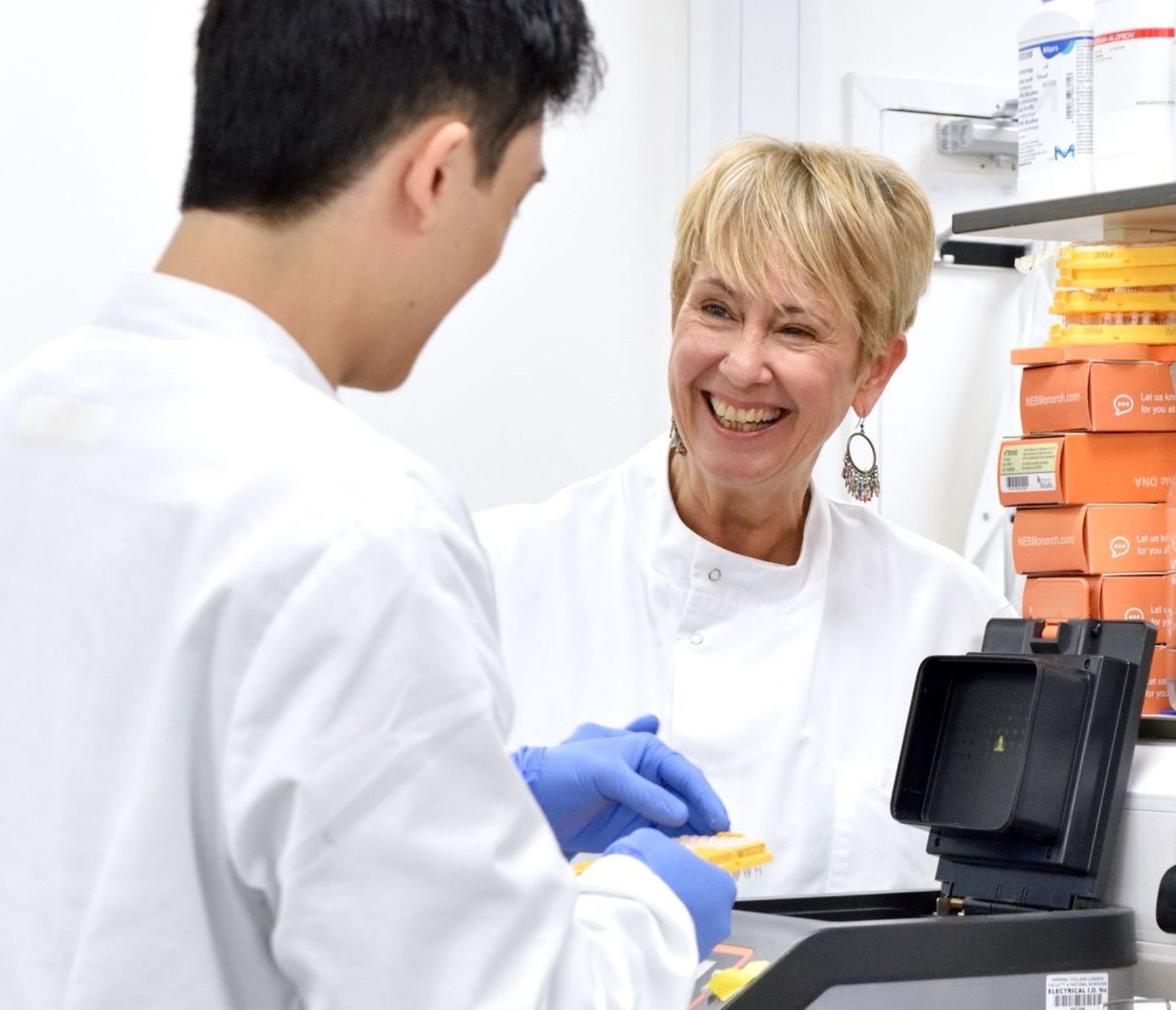
Erol Gelenbe FIET FIEEE FACM is the Dennis Gabor Professor and Head of Intelligent Systems and Networks in the Electrical and Electronic Engineering Department at Imperial College. Prior to Imperial, he was the Associate Dean of Engineering and founding Director of the School of Electrical Engineering and Computer Science at the University of Central Florida. Prior to that at Duke University, he was the Nello L. Teer Professor and Head of the Department of Electrical and Computer Engineering, with secondary appointments as Professor of Computer Science and of Experimental Psychology. Before Duke, he was a Professor at the University of Paris and also taught at Ecole Polytechnique. During his twenty years in France, he created research groups in "computer and network performance evaluation" at INRIA and French universities, founded two post-graduate programmes, introduced system and network performance evaluation methods to France Telecom and other ITC companies, and contributed specific techniques to commercial performance evaluation software packages such as QNAP2. He was appointed to his first chair at the age of 27 at the University of Liege (Belgium). http://www.sigmetrics.org/achievementaward-2008.shtml
Erol's current research includes four externally funded projects (1) SATURN on Network Security (BT and the Technology Strategy Board), (2) Fit4Green on Green ITC (EU FP7), (3) ALADDIN on Distributed Data and Decision Systems (BAE Systems and EPSRC), (4) EU FP7 DIESIS on Distributed Simulation of Critical Infrastructures (ending March 2010). He teaches a course on the performance of distributed systems and networks at the undergraduate and postgraduate levels
For recent publications and those of his group see: http://san.ee.ic.ac.uk and http://s.ee.ic.ac.uk
Erol is a Member of the French National Academy of Engineering http://www.academie-technologies.fr , of the Turkish Academy of Sciences http://www.tuba.gov.tr and of Academia Europaea http://www.acadeuro.org. He received the ACM SIGMETRICS Life-Time Achievement Award http://www.sigmetrics.org/achievementaward-2008.shtml, the Grand Prix France Telecom of the French Academy of Sciences (1996) and the Parlar Science Award of Turkey in 1994. He was awarded Doctor Honoris Causa degrees by the University of Roma Tor Vergata, Italy (1996), the University of Liege in Belgium (2006), and Bogazici University in Turkey (2004). He was awarded the honours of Grand Officer of the Order of the Star of Solidarity by the President of Italy in 2007 http://www.quirinale.it/elementi/DettaglioOnorificenze.aspx?decorato=225017 and of Commander of Merit of the Republic of Italy in 2005 http://www.quirinale.it/elementi/DettaglioOnorificenze.aspx?decorato=165072. France awarded him the Officier du Mérite (2001) and the Chevalier des Palmes Académiques (2003). Since joining Imperial in 2003 he has graduated nine PhDs, and overall has graduated more than fourty-five Ph.D.s who work in academia and industry. He is a co-author of four monographs in English, two of which have also appeared in French, Japanese and Korean.
Erol served as Science and Technology Advisor to the French Minister of Universities (1984-86), as Chair of the Technical Advisory Board of the US Army Simulation and Training Command (2000-03), as Member of the Executive Board and of the Science and Technology Board of the Data and Information Fusion Defense Technology Centre in the UK (2003-2009), as consultant to Oxford University Press (2008-present), and serves as a consultant to industry. He is the Editor-in-Chief of the Computer Journal, and serves on the editorial board of other journals including the Proceedings of the Royal Society, Acta Informatica, and Perfroamnce Evaluation.
Specific Research Details: Prof. Erol Gelenbe works on computer and network system performance evaluation methods and tools. His early work in this area was incorporated into the QNAP2 commercial software package. He has also introduced new queueing models with product form solution known as G-networks. His currently designs novel distributed systems and networks, including self-improving and self-healing packet network systems. His laboratory includes a large scale wired network test-bed, an ad hoc wireless network that incorporates power aware routing, and wireless sensor networks, and has been supported in recent years by industry including BT, BAE Systems, GD UK Ltd, QinetiQ, as well as UK EPSRC, UK Technology Strategy Board, MoD and he European Union FP6 and FP7 programmes.
Erol also introduced new computational models of biological systems such as the "Random Neural Network", and conducts research on probability models inspired by computer science, economics, biology and physics. The "Random Neural Network" has resulted in a patented technique for anomaly detection in Magnetic Resonance Images of the brain, and in the patented CPN algorithm for QoS routing in "autonomic" or self-aware adaptive networks (http://san.ee.ic.ac.uk). He also investigates equilibria in large agent populations which may have collaborative or adversarial behaviours, as in economics, biology, chemical reactions, gene regulatory networks, network security or software agents. Some of his recent work analyses the time that it takes to "search" when one has imperfect or wrong information about the location of the object that is being sought; this is relevant to wireless networks, to robotics and optimisation.
His early work has contributed seminal results on the performance of random access multi-user communications, diffusion models of multi programming systems, adaptive control and performance of virtual memory systems, on optimum checkpoints in databases, and the evaluation of database operations. In the field of queueing theory, Erol has introduced new "product form" queueing network models that incorporate control functions (such as workload re-routing and work removal) called G-networks.
Prof Gelenbe's research group addresses two related areas:
- Wired and Wireless "Autonomic" or self-aware and self-organising Network Design and Optimisation, including sensor networks, with support from British Telecom (Project Hyperion), EU FP6 (Project Cascadas), EU FP7 (Project DIESIS), MoD, IBM, the US/UK International Technology Alliance on Sensor Networks, an d the UK Technology Strategy Board.&n bsp; http://san.ee.ic.ac.uk
- The behaviour, performance and control of systems of interacting collaborative or adversarial agents, including networked a uctions, with support from EPSRC, BAE Systems Ltd, GD UK Ltd, and MoD with applications in emergency management and evacuation, and netwo rk security and protection. Probability models of networked systems in engineering, physics and biology, including neural networks, chemical reactions, sensor networks and economic agents in the Internet. http://sa.ee.ic.ac.uk.
Prof Gelenbe's journal publications in 2006-2010 appear in the Communications of the ACM, ACM Trans. on Sensor Networks, ACM Trans. on Internet Technology, Physical Review E, Proceedings Royal Society A, ACM Trans. on Adaptive and Autonomous Systems, Computer Networks, Neural Computation, The Computer Journal, IEEE Trans. on System Man and Cybernetics B, etc.